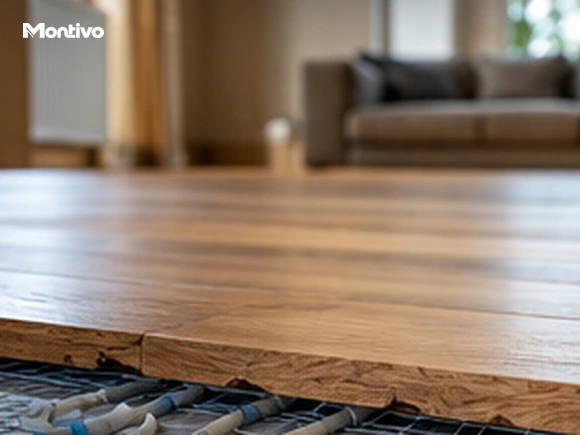
Wood and underfloor heating are not automatically incompatible. The opposite assumption is equally misleading: not every wooden floor can be laid over every heating system without conditions. Compatibility concerns the combination of flooring, substrate, fixing method and controls.
Buildwise identifies residual moisture, a commissioning protocol, an appropriate adhesive and suitable timber selection among the relevant conditions. [1] A label stating suitable for underfloor heating therefore begins the checks; it does not complete them.
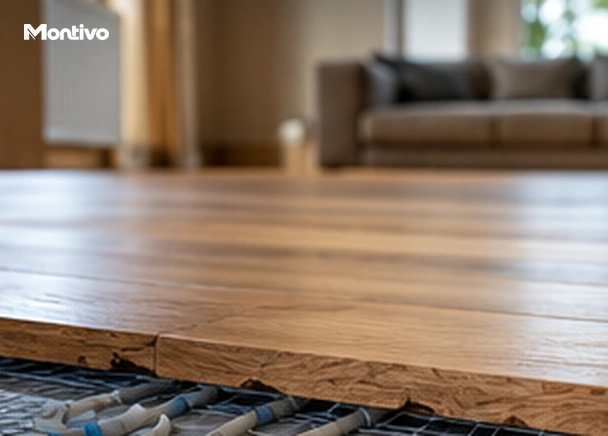
Confirm the exact floor product
Request the selected product’s technical information, including thickness, construction and permitted installation methods. A statement about one collection does not automatically cover every board from the same brand. The intended combination with the heating system needs to be demonstrably suitable.
Solid wood is not excluded as an entire category, and engineered wood is not automatically approved. Width, species, construction and installation requirements may matter. Ebeco likewise refers compatibility back to the flooring supplier’s instructions. [5]
Keep the approved product references before ordering. If thickness, underlay or adhesive changes later, reassess that change rather than treating it silently as equivalent.
Thermal resistance involves the whole build-up
Wood and any intermediate layers resist heat flow. This property is expressed as thermal resistance. Design needs to consider the relevant combination of flooring and intermediate layers, not the board alone. Junckers gives examples of different layer combinations in its technical guidance. [3]
Have the heating designer assess whether the required output is achievable within the permitted floor temperature. A thicker assembly or different underlay can change the calculation. A wooden floor feeling comfortable underfoot does not establish that the heating will meet demand on the coldest day.
Compare more than the price and colour of two floors. Ask what each means for the heating design, especially in a renovation of an existing building.
Measure residual moisture rather than counting days
A screed can appear dry on top without being ready for flooring. Screed type, test method and the flooring and adhesive requirements determine the assessment. Buildwise expresses moisture conditions with reference to application and measurement method. [2]
A calendar rule or completed heating programme does not replace appropriate testing. Record where and how measurements were taken and which limits apply to the selected system. Relative humidity readings are not directly interchangeable with moisture expressed as a percentage by mass.
Testing should be planned by someone who knows where the heating pipes run. Any moisture-control layer must also suit the substrate and complete system; it is not a blanket exemption from further assessment.
Coordinate commissioning and installation conditions
Before flooring starts, establish the initial commissioning and drying protocol applicable to the screed and heating. Agree who will carry it out and how it will be recorded. Installation conditions then need to meet the requirements of the flooring, adhesive and any intermediate layers.
Agree storage and acclimatisation too. Leaving packs open for an arbitrary number of days is not a universal method. The product instructions determine how material should be stored on site and when it may be installed.
After laying, return to service according to the chosen system. Raising the temperature too early or abruptly to speed up adhesive drying is not a substitute for the specified curing process.
The substrate and adhesive still need full attention
A suitable temperature does not correct poor flatness, weak layers or loose dust. Assess the substrate for strength, cracking, contamination and the intended joint arrangement. Adhesive must suit the parquet, base and heated application.
Junckers sets out separate system requirements for glued flooring over underfloor heating. [4] This illustrates why flooring, adhesive, primer and any moisture control need selection as a combination. Do not copy an isolated threshold from another market or assembly without checking that it applies.
Record which existing joints will be maintained and how edges and connections will be detailed. These are installation decisions, not merely finishing touches to resolve later.
Surface temperature is not water temperature
Junckers’ general technical guidance, for example, specifies a maximum of 27 °C at the timber surface. [3] That is a system-specific reference, not a universal thermostat setting for every wooden floor. Heating-water flow temperature is a different measurement.
Follow the requirements of the actual floor-and-heating combination and set up controls accordingly. Thick rugs or low enclosed furniture can influence local heat accumulation. Discuss the eventual furnishing arrangement, not only the empty room during installation.
Approval for heating does not automatically approve floor cooling. Cooling requires a separate assessment of the system and condensation-risk control.
Retain the handover records
Keep product information, moisture results, the commissioning record and use and maintenance instructions. Have the applicable temperature limits and restart procedure after prolonged shutdown explained clearly.
It is worth identifying a point of contact for changes after handover. A future change of thermostat, underlay during a repair or floor covering in an adjoining area should not be assumed to leave all original conditions unchanged.
Montivo can coordinate flooring selection and substrate preparation with the heating installer involved. A reliable result starts with the floor and heating being assessed together, before the first board is laid.
Sources and technical background
- Buildwise — Peut-on poser un parquet sur un support muni d’un système de chauffage par le sol ?
- Buildwise — Quel doit être le taux d’humidité d’une chape à base de ciment destinée à recevoir un parquet ?
- Junckers — Underfloor Heating: General information E 4.0
- Junckers — Glued wood floors with underfloor heating E 4.3
- Ebeco — Underfloor heating for wooden floors
This article provides general considerations. Site assessment and the current requirements of the selected system determine the installation.