Choosing kitchen fronts quickly brings up the question: lacquer, laminate or veneer? These terms are sometimes presented as three distinct quality levels. In reality, they do not fully describe the door, its edge detailing or its behaviour in everyday use.
A useful comparison separates the supporting board, visible surface and protective finish. It then considers appearance, maintenance and repair. That helps you select not merely an attractive sample, but a front whose construction suits the kitchen.
Start with construction rather than the sales label
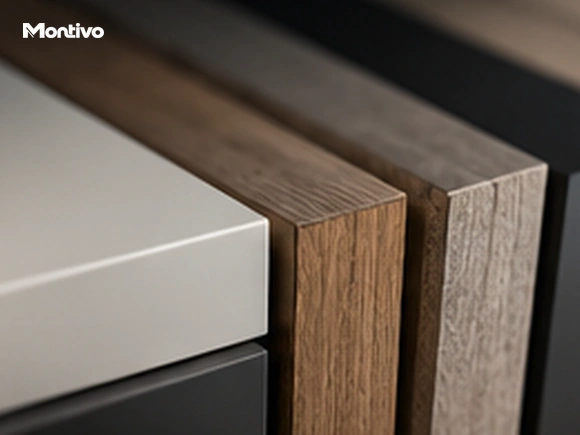
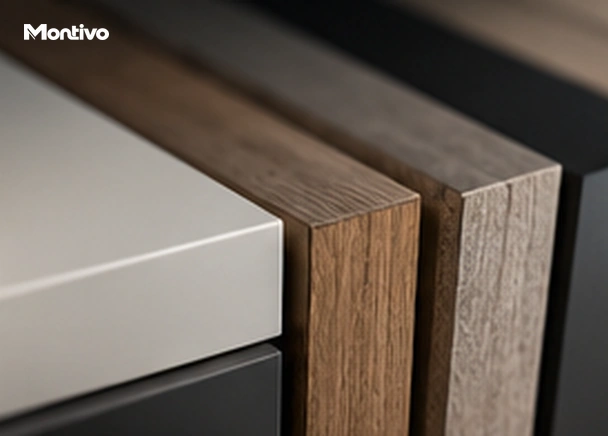
The core is the panel that carries the shape and fixings. The visible layer determines what you see and touch. A further finish may cover it. A veneered panel can, for example, be lacquered, and lacquered decorative panel products also exist. The categories are therefore not always mutually exclusive.
Ask for the complete specification: core material, surface, both faces and edge construction. EGGER distinguishes several board and surface types in its kitchen range. [1] A label such as super-matt or wood-look is not a full description.
Include thickness and weight in the design. They affect connections to existing units and need to suit the selected hardware. This is particularly relevant when new fronts are being fitted to cabinets that will remain in place.
Lacquered fronts: more than a colour code
A lacquered front has a coating applied to an appropriately prepared surface. The result depends on preparation, the coating system, sheen and the shape of edges or profiles, not only the chosen colour.
Request an actual product sample and inspect it in daylight and under the kitchen lighting. A smooth high-gloss surface is assessed differently from a matt profiled door. Establish how the rear face and every edge will be finished. This avoids surprises when doors are open.
An attractive appearance does not mean unlimited scratch or impact resistance. Match performance and care expectations to the chosen product documentation. Local refinishing may be possible, but an invisible repair should not be promised without assessment.
Laminate, melamine and foil are not one material
Decorative panels can look similar while using different constructions. HPL and directly melamine-faced boards are not identical. Foil-wrapped fronts are another category. IKEA, for example, distinguishes foil, lacquer and melamine laminate when describing front options. [3]
Ask what is actually being supplied rather than comparing only the word laminate. Inspect the panel edge: how does it meet the face, what sits behind it and how are cut-outs finished?
A decorative pattern may be consistent, but damage to a printed surface cannot be treated like damage to solid wood. Discuss replacement of an individual front and the potential availability of the same décor later. Do not assume a future batch will match without checking.
Veneer is real wood, but not necessarily solid wood
Veneer consists of thin layers of genuine timber applied to a supporting panel. Decospan explains that distinction between the wood layer and its substrate. [2] The grain is not merely a printed image, but the whole door is not necessarily solid timber either.
Grain direction and distribution deserve attention. Ask whether it will be coordinated across neighbouring doors and what colour variation is acceptable. Manufacturers of finished veneer identify natural differences in tone and grain. [5] A small sample cannot therefore predict the appearance of an entire kitchen.
Veneer is not permission for unlimited sanding after damage. The remaining wood layer and existing finish require assessment. Specify whether it will be lacquered, oiled or otherwise protected, and how that system should be maintained.
Edges and use matter just as much
Consider the sink, dishwasher and oven areas and the points repeatedly touched when opening doors. Ask about permitted exposure to heat, steam and water. A water-resistant face does not automatically give every edge or damaged spot the same protection.
Separate easy cleaning from resistance to damage. Anti-fingerprint does not mean scratchproof. A dark matt colour may look different from a light textured décor after handling or cleaning, but the actual behaviour is product-specific. Test the sample using the approved care method, not arbitrary aggressive products.
EGGER recommends mild cleaning for its laminate surfaces and warns against abrasive or film-forming products. [4] Follow the instructions for the selected front; one recommendation cannot automatically be transferred to every lacquer and veneer finish.
Compare complete doors rather than labels
A meaningful comparison includes material, edges, hardware preparation, rear face and installation. Add handles or handleless details, visible end panels and fillers. Otherwise, a fully finished proposal is being compared with the price of a board alone.
Ask the same questions of each candidate: how will it look in this kitchen, how is it maintained and what happens after damage? Decide from those answers rather than a general ranking from budget to premium.
A sample starts the decision
Montivo can review material samples alongside the existing kitchen. The objective is an appropriate combination of appearance, construction and practical maintenance, with clear agreements before the fronts are made.
Sources and technical background
- EGGER — Product solutions for the kitchen
- Decospan — What is wood veneer?
- IKEA Belgium — How to choose kitchen cabinet doors and fronts
- EGGER — How should I clean and maintain my EGGER Worktop?
- Fritz Hansen — Veneer lacquered or coloured wood: care and maintenance
This article provides general considerations. Site assessment and the current requirements of the selected system determine the installation.