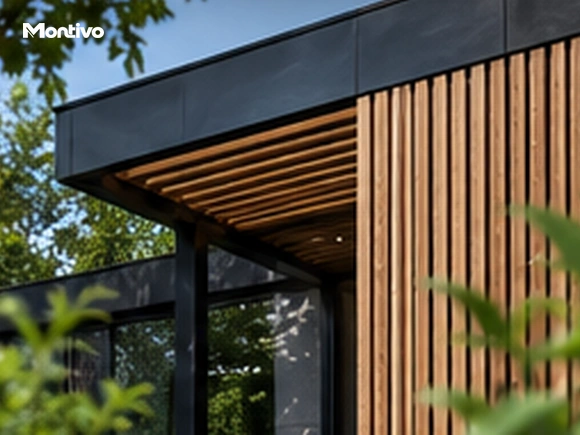
Timber cladding, pergolas and carports change as they are exposed to the weather. Not every colour change means the wood is damaged. Equally, a new coat of oil or paint cannot solve a drainage, fixing or timber-condition problem.
Three questions should be kept separate: is appearance mainly changing, is the protective finish worn, or is there a problem with the material or construction? Answering them first prevents an attractive new surface from concealing an unresolved defect.
Greying is not the same as decay
Hout Info Bois describes greying as a natural change at the exposed surface under light and water. Greying alone does not mean that mechanical properties or durability have been lost. [1] A silver-grey colour is therefore not an automatic reason to replace cladding.
The process can be uneven. Timber beneath an overhang receives different exposure from areas in full sun or rain. Accoya identifies shading and exposure among factors affecting appearance. [2] Compare several areas rather than judging only the most discoloured patch.
Choosing natural weathering does not mean abandoning inspection. An uncoated surface can still form part of a construction whose fixings and water management need maintenance.
Assess dark or green marks before treating them
A dark patch can have several causes. Colour alone does not establish decay, mould or a coating defect. Consider its position, pattern, moisture exposure and relationship to metal components or adjoining details.
Compare appearance in dry conditions and record where marks recur. Softened areas, loose fixings, substantial distortion or persistent wetting justify further material assessment. Cleaning the surface and checking structural capacity are different interventions.
For load-bearing parts of a pergola or carport, doubts about condition should be resolved before cosmetic work. An attractive coat of paint provides no evidence of the strength of the timber beneath it.
Timber selection and detailing belong together
Not every timber is suitable for every exterior use. Sapwood, exposure and the selected assembly can affect the assessment. Hout Info Bois links the suitability of cladding timber to material selection, ventilation and fixing details, among other factors. [3]
Look for places where water remains or repeatedly wets the timber. Pay attention to end grain, horizontal surfaces, post bases and junctions with other materials. Also check whether the intended air path behind cladding remains open.
A coating can contribute to protection, but it cannot replace a detail that sheds water and allows drying. Correct a problematic connection before applying another treatment to the same affected spot.
Where access is difficult, include a safe inspection method in the maintenance plan. Avoid making the coating decision solely from ground-level photographs of areas that cannot be properly examined.
When renewing the finish is sufficient
If timber and fixings remain suitable and the coating is the main issue, maintenance of that finish may be appropriate. Existing coating, adhesion, contamination and moisture condition determine preparation. Locally peeling paint needs a different response from an evenly weathered oiled surface.
Accoya advises addressing damage to paint in good time to reduce moisture becoming trapped beneath the coating. [4] This supports inspection, but it does not establish a universal interval for every timber and finishing system.
Prepare a trial area and examine it after drying. Record which old layers remain, which will be removed and which new system is compatible. Unidentified older layers require assessment of the material and a safe working method before removal.
Select the finish for its application
Vertical cladding, a horizontal deck and dimensionally sensitive window joinery experience different conditions. Buildwise therefore discusses exterior wood finishes by their field of application. [5] Colour or the label outdoor is not enough to select a system.
Discuss the intended appearance: visible grain, an opaque colour or natural weathering. Then ask about suitability for the timber, preparation, coverage and maintenance. A transparent product does not automatically provide the same resistance to colour change as every pigmented finish; its actual specification matters.
A sample on the real substrate helps establish colour, absorption and sheen. Do not expect a small colour card to demonstrate that all existing differences between boards will disappear.
Plan maintenance around actual condition
A promise of years without attention means little without material and exposure information. Instead, agree an inspection plan identifying highly exposed locations and signs that require action.
Start cleaning with a controlled, suitable method and a trial. Aggressive cleaning without material assessment can leave an unwanted surface. Establish when refinishing is permitted and how drying and weather conditions will be checked. A forecast of dry weather does not by itself describe the moisture condition of the timber.
Keeping dated photographs of the same areas can make changes easier to recognise. Record previous products as well, so the next maintenance decision does not start with an unidentified coating history.
Define the renovation scope clearly
A proposal should distinguish cleaning, coating maintenance, local timber repair, replacement and changes to construction details. Ask what is thought to cause recurring marks and which checks are needed to confirm that explanation.
Montivo can discuss which parts need maintenance and where investigation should come first. The objective is not just timber that looks tidy again, but a solution in which material, finish and detailing work together.
Sources and technical background
- Hout Info Bois — Vergrijzing van hout: oorzaken, risico’s en oplossingen
- Accoya — Owning Accoya: performance and care
- Hout Info Bois — FAQ: hout, gevelbekleding en behandelingen
- Accoya — Care and maintenance FAQs
- Buildwise — Afwerkingen voor buitenhoutwerk: classificatie op basis van het toepassingsgebied (2018-04.08)
This article provides general considerations. Site assessment and the current requirements of the selected system determine the installation.