A dull wooden floor with visible wear can quickly look like a candidate for complete sanding. Yet different problems can appear similar from a distance. Accumulated care products, superficial wear and damage extending into the timber do not necessarily require the same treatment.
The right decision begins with identifying the floor construction and its existing finish. Cleaning, renewing the protective coat and sanding back to bare wood can then be compared properly. This avoids both unnecessary heavy work and a light treatment that leaves the actual problem unresolved.
Identify the floor before selecting a treatment
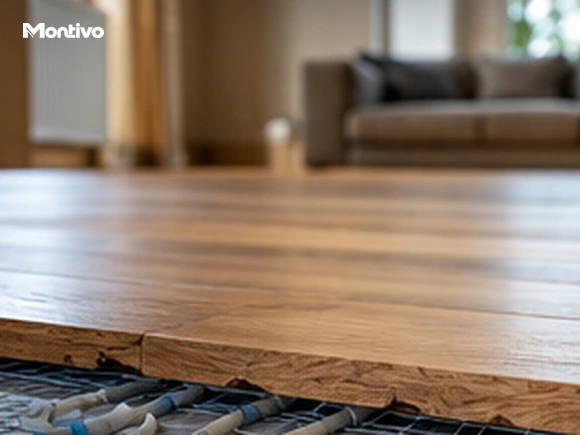
Solid wood flooring is timber throughout its thickness. Engineered flooring has a wood wear layer over a composite structure. Thin wood-veneer flooring can also look very similar. The total board thickness therefore does not tell you how much wood can safely be removed.
Find the product information and any record of previous renovation. Where possible, have an exposed section and the remaining wear layer examined. Bevels, texture and edges also matter. Missing information is uncertainty to resolve, not permission to start sanding regardless.
Photograph traffic routes, areas usually covered by furniture and individual defects. This helps separate the floor’s overall appearance from local damage and makes the brief more useful.
Clean before removing material
Appropriate deep cleaning can help establish how much of the dull appearance comes from dirt or maintenance residues. Select a method for the existing finish and test it first. More water or a stronger chemical is not automatically better. Kährs distinguishes routine cleaning, maintenance and renovation in its care guidance. [3]
Assess the trial area after it has dried. If a haze disappears but marks remain, that provides useful information for the next decision. Cleaning cannot erase a dent or deep scratch; its purpose here is to create a reliable basis for assessment.
Renew the protection without sanding everything bare
Some existing finishes can be prepared and given a compatible new protective coat. This is commonly called recoating. Bona describes it as a lighter renovation that retains more of the existing wood surface. It does not remove deep scratches in the timber. [1]
It is therefore not a universal answer for every worn floor. Ask whether the damage lies in the finish or extends into the wood, and what outcome is realistic. A different sheen can change the overall impression while a defect remains visible. Establish that through a trial area rather than a broad promise.
Previous maintenance affects preparation
Identify the soaps, polishes, waxes and other treatments used on the floor. Their residues can influence the bond of a new coat. Bona’s guidance links recoating to appropriate cleaning and preparation, with further checks where residues are uncertain. [2]
Assess compatibility between the existing and proposed finishes. A trial in an inconspicuous area should receive the same preparation planned for the whole floor. Evaluate not just colour, but adhesion and appearance after the required curing period. An oiled floor needs a maintenance treatment suited to its existing oil system. [4] Maintenance oil is not an interchangeable replacement for lacquer.
When full sanding is worth considering
Full sanding may be appropriate where the finish is heavily worn, a substantial colour change is intended or a surface treatment is insufficient. First establish that enough suitable timber remains. Even then, deep staining and damage require an honest assessment.
Discuss which areas may need separate repair or board replacement. A dark patch is not necessarily confined to the finish. Loose boards, moisture problems and distortion are not corrected simply by sanding their top surfaces. Those causes should be investigated before a new finishing system is selected.
Compare the complete scope
For each option, ask about preparation, local repairs, edges, skirting boards and the selected finish. Have the likely remaining marks described. A quote for cleaning and maintenance is not equivalent to one for full sanding and refinishing.
Include practical arrangements: moving furniture, protecting adjacent rooms, dust extraction, ventilation and permitted use after treatment. Dust extraction does not mean the home will remain completely dust-free. The stages for careful foot traffic, returning furniture and damp cleaning must follow the chosen system.
It also helps to agree the intended appearance under the room’s normal lighting. A close-up of one scratch is useful, but it should not be the only reference for approving an entire floor. Record the sample area and the agreed scope so that the final assessment uses the same expectations.
Can every engineered floor be sanded?
No. The remaining wear layer, earlier work and product construction determine that. Ask for an assessment of your floor rather than a blanket statement about all engineered flooring.
Will the renovated surface look identical everywhere?
That cannot be promised without inspection. Natural timber variation, old discolouration, repairs and local wear may remain visible. A trial area helps align expectations with the actual material.
Choose the least intrusive treatment that fits
The objective is not automatically the heaviest intervention, but one that matches the floor’s condition. Discuss the floor, its maintenance history and the desired outcome with Montivo. The choice between refreshing and complete renovation can then be made on a clear, practical basis.
Sources and technical background
- Bona — Recoating: renew your floors
- Bona — Frequently asked questions for professionals
- Kährs — How to maintain wood floors for commercial areas
- Osmo Nederland — Maintaining wooden floors
This article provides general considerations. Site assessment and the current requirements of the selected system determine the installation.