A worn staircase does not automatically need replacing. Its main problem may be a yellowed finish, damaged tread edges or an appearance that no longer suits the interior. In other cases, movement, loose connections or deteriorating timber matter more than the visible surface.
A sensible renovation therefore begins with two separate questions: is the structure serviceable, and what finish is achievable? Only then does a comparison between restoration, refacing and replacement become useful. An attractive new surface cannot make an unreliable staircase safe.
Examine the whole staircase
Look beyond the top of each tread. The assessment should include strings, joints, risers, the handrail and connections to adjoining floors. Strings are the supporting side members; risers are the vertical parts between successive treads. Identify where movement occurs and whether components are visibly loose.
A squeak alone is not a complete diagnosis. Investigate its cause rather than automatically adding screws or covering it up. Visible distortion, deterioration or uncertainty about load-bearing parts calls for a structural assessment before finishing. An unstable staircase should not become a test bed for a cosmetic fix.
Also establish which surfaces will remain exposed. The undersides and edges of an open staircase require more attention than those of an enclosed stair against a wall.
Restore and refinish the existing timber
Keeping the original timber makes sense when the structure is suitable and the desired result is compatible with the material. A trial area can show what emerges after the existing finish is removed: timber colour, old repairs, wear marks or differences between components.
Do not promise that every stain will disappear. Agree which marks are acceptable and which parts may need replacing. Buildwise highlights the importance of clear expectations about the appearance of wooden stairs. [1] A sample on the actual timber is more useful for that discussion than a colour seen only on a screen.
Unidentified old coatings also require an assessment of the material and a safe working method before removal. The aim is a predictable result, not the maximum possible removal of wood.
When an overlay is an option
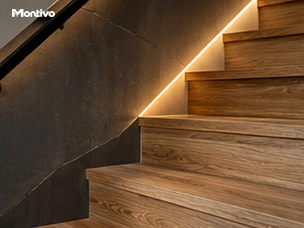
Overlay treads may be appropriate where the existing staircase remains a suitable base but its visible surface cannot deliver the intended appearance. Manufacturers offer stair-renovation systems with coordinated treads and profiles. Their application conditions and installation instructions still govern their use. [2]
An overlay adds thickness. Check the resulting riser heights, top and bottom transitions, tread edges and available clearances. Riser height is the vertical difference between consecutive steps. Looking only at the middle of the flight is insufficient: the first and last steps must also connect properly to the floors.
Ask for details of the nosing, exposed side and landing junction. Selecting a decorative finish does not resolve those connections. Nor should covering a staircase be treated as an automatic repair for a loose or weakened base.
Consider finish and grip separately
Oil and lacquer describe families of finishing systems. Compare their specifications, care requirements, repair options and appearance. A matt finish is not automatically slip-resistant; a rougher feel is not a complete performance assessment either.
Some products intended for stairs declare particular slip-resistance properties. Those properties belong to the tested system and its specified application, not to all oils or lacquers. [3] Lighting, the handrail and the visibility of tread edges matter as well. A safe staircase involves more than one surface treatment.
Approve a colour and sheen sample and agree the future maintenance method. An appealing finish should also suit the staircase’s everyday use.
Plan for a staircase that people still need
Stairs are often the only access to an upper floor. Discuss access before work begins, particularly where bedrooms or bathrooms are upstairs. The plan must account for preparation, repairs, application and the period before the finish can withstand normal use.
Dust-dry, suitable for careful foot traffic and fully cured describe different stages. Follow the current instructions for the selected system instead of assuming every product has the same waiting period. [4] Also agree when temporary covering, intensive cleaning and furniture movement are permitted.
Include protection of neighbouring walls and floors, dust control and finishing of sides and handrails in the scope. Otherwise, precisely those visible items may be missing from the comparison.
When replacement deserves consideration
Replacement should be assessed seriously if the load-bearing structure is problematic, the geometry cannot remain suitable or the intended change goes well beyond a surface renovation. That decision should not be made from a single photograph.
Request clearly defined alternatives. Compare repair of the existing stairs, an overlay system and replacement with the same attention to safety, finish and use. A price per tread is meaningful only when its inclusions and exclusions are clear.
Start with the right intervention
Discuss the condition of the staircase, the intended appearance and daily access with Montivo. A focused assessment and an approved sample provide a sound basis for choosing a renovation that actually fits the existing situation.
Sources and technical background
- Buildwise — Vermijd discussies over het uitzicht van houten trappen (2026-03.02)
- Quick-Step — Installing laminate, vinyl or wood on your stairs
- Osmo — Polyx-Oil Anti-Slip
- Osmo — Polyx-Oil Original
This article provides general considerations. Site assessment and the current requirements of the selected system determine the installation.